


BIX ARTICLE
Accelerating South-East Asia’s Green Transition
Dec 02, 2025
|
6 min read
Featured Posts
Social Bonds Illustrative Use-Of-Proceeds Case Studies Coronavirus
Jul 06, 2020
|
2 min read
Sustainable Banking Network (SBN) Creating Green Bond Markets
Jul 06, 2020
|
2 min read
Why is Inflation Making a Big Comeback After Being Absent for Decades in the U.S.?
Mar 24, 2022
|
7 min read
SC issues Corporate Governance Strategic Priorities 2021-2023
Mar 29, 2022
|
3 min read

One for the album: (from left) Mak, Fernandes, Standard Chartered Malaysia chairman Tan Sri Shahril Ridza Ridzuan, Nazir, Lim, Chow and Standard Chartered Saadiq Malaysia chief executive officer Bilal Parvaiz posing for the cameras.
|
The Southeast Asia’s Green Economy Report 2025, jointly developed by Bain & Company and Standard Chartered together with partners Temasek, GenZero and Google, outlines the region’s progress in building a green economy – and how it can sustain its transition even as it faces headwinds from global trade tensions, uneven national policies and continued fossil-fuel dependence.
In a discussion on the region’s green economy, Bain & Company Partner for Jakarta, Dominik Utama, and Standard Chartered Head of Coverage for Singapore and Asean, Chow Wan Thonh, underscored the immense economic and environmental potential of pursuing a green growth pathway for the region.
According to the report’s analysis, embracing green growth could add around US$120bil each year to South-East Asia’s GDP by 2030 – a two-per-cent boost to annual growth beyond business as usual.
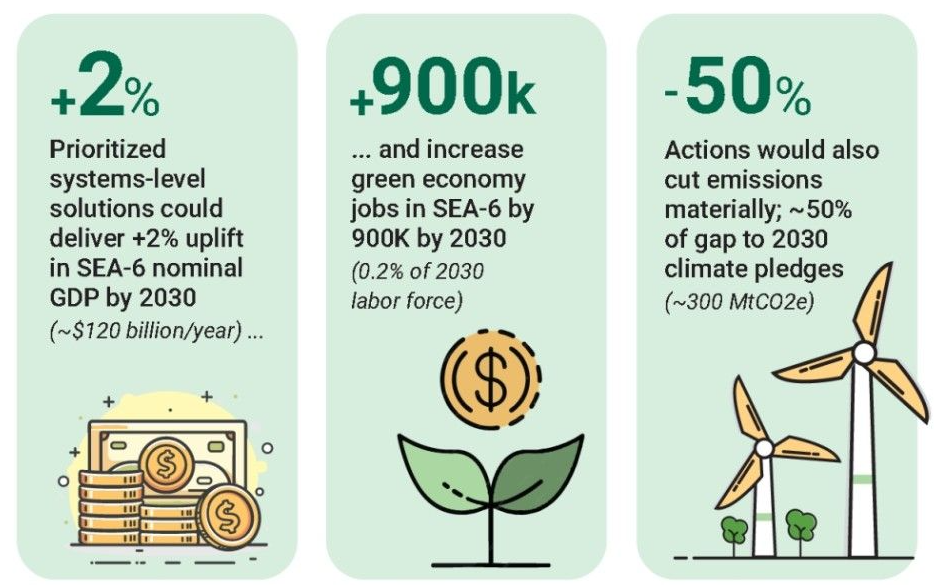
These gains extend beyond macro-economics: an estimated 900,000 new jobs could be created across the region, from project development for nature-based solutions and electric-vehicle production to building retrofitting, grid engineering and AI-driven green innovation.
Just as importantly, the report shows that these economic benefits come while tackling climate change. By taking a systems-based approach, South-East Asia could avoid 300 million tonnes of CO2 equivalent, closing roughly half of the region’s current gap toward meeting its 2030 Nationally Determined Contributions.
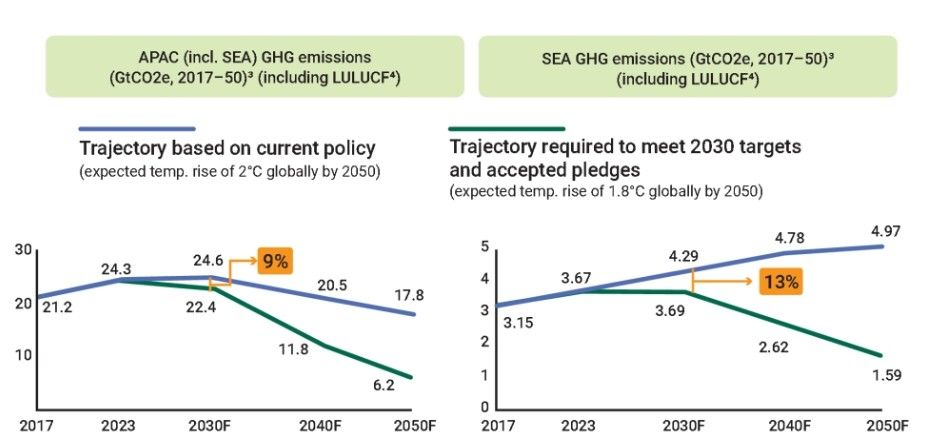
Still, despite progress, South-East Asia and the wider Asia-Pacific region are projected to miss their 2030 climate targets by about 9%–13%. A shift in approach – linking energy, industry, finance and policy as part of one interconnected system – could help unlock both economic gains and emissions reductions.
This view also frames the region’s priority sectors. The report identifies several key drivers: the bio-economy as a new source of sustainable growth; the expansion of electric mobility, supported by policy incentives and infrastructure upgrades; and the development of carbon markets to monetise emissions reductions and promote transparency. Together, these elements form the backbone of an integrated, region-wide transition strategy.
Zooming in on Malaysia, Chow shared the country’s encouraging momentum—it is on track towards net zero by 2050, with interim goals of a 45% reduction in greenhouse-gas emissions by 2030 and 40% renewable energy by 2035, guided by the National Energy Transition Roadmap (NETR). Renewables already account for 19% of Malaysia’s energy mix, while green investments surged 124% to US$2bil in 2024.
Among the accelerators driving this progress are Malaysia’s expanding mandatory emissions reporting, now extended to private firms, and early carbon-market developments that formalise emissions pricing. Incentives for renewable energy and electric vehicles are further redirecting capital toward cleaner solutions.
Yet, challenges remain. Global headwinds have slowed investment inflows, competing corporate priorities risk diluting sustainability commitments, and grid upgrades are urgently needed to integrate higher shares of renewable power.
The report concludes that sustaining momentum will require translating ambition into coordinated action. Collaboration, between governments, businesses and financiers, and across borders, will be essential to maintain the pace of transition.

Opportunities must be seized even amid global volatility, and systemic barriers can be dismantled only through coordinated transformation.
Going green is not just an environmental imperative; it is an opportunity to redefine growth, resilience and competitiveness for the decade ahead.
For South-East Asia, the green transition is no longer a niche agenda but a central pillar of its future growth.
Following the discussion of the Southeast Asia’s Green Economy Report 2025, the dialogue at the Asean Green Shift Forum deepened into a wider conversation on how the region can collectively accelerate its journey toward a sustainable, low-carbon future.
Held alongside the 57th Asean Economic Ministers’ Meeting in Kuala Lumpur, the forum brought together policymakers, business leaders and sustainability advocates in a full day of dialogue and collaboration.
Organised by Standard Chartered Malaysia, in partnership with the Asean Business Advisory Council (Asean-BAC) and supported by knowledge partners Yinson Holdings Bhd and the Malaysia Carbon Market Association (MCMA), the event reflected the bank’s leadership in advancing sustainability and sustainable finance across the region.
The forum’s agenda set the tone for the day. Standard Chartered Malaysia chief executive officer Mak Joon Nien opened the session with a welcome address that underscored the importance of partnerships and shared responsibility in driving Asean’s green transition.
This was followed by a keynote speech from Asean-BAC 2025 chairman Tan Sri Nazir Razak, who urged Asean industry and corporate leaders to collectively champion the transition towards a more sustainable Asean.
Building on that foundation, the panel discussion titled “Malaysia’s 2025 Asean Chairmanship: Leading the Charge Toward Integrated Regional Carbon Markets” explored how corporations can move toward a harmonised carbon trading framework.
Moderated by Mak, the panel featured Malaysia Carbon Market Association president and Yinson’s corporate sustainability group head Dr Renard Siew, Bursa Malaysia carbon markets head Dr Chen Wei-Nee, Climate Impact X origination and strategic partnerships head Saurabh Joshi and Standard Chartered carbon markets development director Lucy Palairet.
In a unique close to the panel, Asean-BAC Malaysia council members, Capital A chief executive officer Tan Sri Tony Fernandes, and Yinson chief executive officer Lim Chern Yuan also shared their distinctive perspectives and insights on carbon markets.
The day wrapped up with a dinner in honour of the Asean Economic Ministers, which brought together over 150 distinguished guests, including Investment, Trade and Industry Minister Tengku Datuk Seri Zafrul Abdul Aziz, delegates from the Philippines, Timor-Leste and Cambodia as well as corporate partners and clients.
The evening’s highlight was a lively dialogue between Tengku Zafrul and Liverpool FC legend Sami Hyypia, moderated by Mak.
Drawing parallels between football and sustainability, their exchange reminded guests that success, whether in sport, business or climate action, is built on teamwork, resilience and leadership.
The day captured the essence of Standard Chartered’s 150th anniversary in Malaysia and the country’s Asean Chairmanship: connecting legacy with purpose, and reaffirming the bank’s commitment to building a sustainable future together with the region it has long served.
Disclaimer
The information provided in this report is of a general nature and has been prepared for information purposes only. It is not intended to constitute research or as advice for any investor. The information in this report is not and should not be construed or considered as an offer, recommendation or solicitation for investments. Investors are advised to make their own independent evaluation of the information contained in this report, consider their own individual investment objectives, financial situation and particular needs and should seek appropriate personalised financial advice from a qualified professional to suit individual circumstances and risk profile. The information contained in this report is prepared from data believed to be correct and reliable at the time of issuance of this report. While every effort is made to ensure the information is up-to-date and correct, Bond and Sukuk Information Platform Sdn Bhd (“the Company”) does not make any guarantee, representation or warranty, express or implied, as to the adequacy, accuracy, completeness, reliability or fairness of any such information contained in this report and accordingly, neither the Company nor any of its affiliates nor its related persons shall not be liable in any manner whatsoever for any consequences (including but not limited to any direct, indirect or consequential losses, loss of profits and damages) of any reliance thereon or usage thereof.
YOU MAY ALSO LIKE

ARTICLE
Oct 09, 2026
|
4 min read
ARTICLE
Oct 07, 2026
|
3 min read
ARTICLE
Oct 01, 2026
|
5 min read
ARTICLE
Sep 29, 2026
|
6 min read