


BIX ARTICLE
Banking tokenisation must be phased and measured — BNM assistant governor
May 14, 2026
|
5 min read
Featured Posts
Social Bonds Illustrative Use-Of-Proceeds Case Studies Coronavirus
Jul 06, 2020
|
2 min read
Sustainable Banking Network (SBN) Creating Green Bond Markets
Jul 06, 2020
|
2 min read
Why is Inflation Making a Big Comeback After Being Absent for Decades in the U.S.?
Mar 24, 2022
|
7 min read
SC issues Corporate Governance Strategic Priorities 2021-2023
Mar 29, 2022
|
3 min read
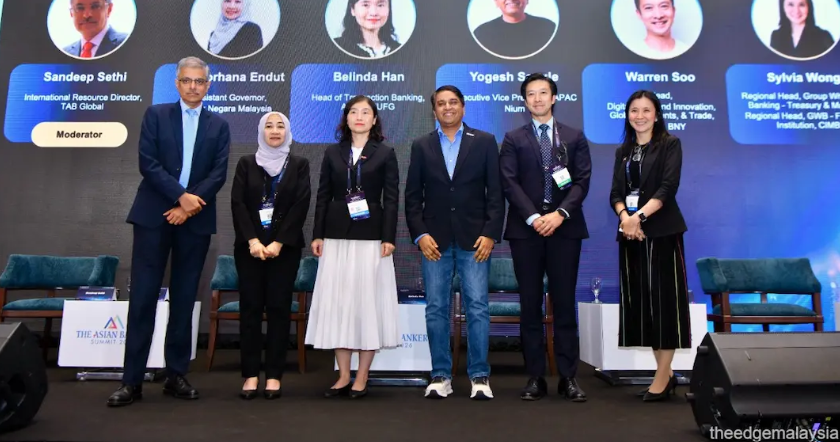
From left: TAB Global international resource director Sandeep Sethi, the moderator, BNM assistant governor Dr Norhana Endut, Belinda Han, the head of transaction banking for Asia-Pacific (APAC) at MUFG, Yogesh Sangle, the executive vice-president of APAC at Niumat, Warren Soo, the head of digital cash and innovation for APAC at BNY, and CIMB regional head of group wholesale banking (treasury and markets) Sylvia Wong at The Asian Banker Summit 2026. (Photo by Sam Fong/The Edge)
Assistant governor Dr Norhana Endut said the central bank is working with industry players through its Digital Asset Innovation Hub to identify practical use cases for tokenisation while exploring the regulatory safeguards needed for wider adoption.
Among the use cases being explored are programmable money, tokenised deposits, atomic settlement and improved liquidity and collateral management, which Norhana said could lead to faster, cheaper and more transparent financial transactions.
“We want to actually design an appropriate regulatory framework that would promote responsible innovation but at the same time ensure that monetary and financial stability is being preserved,” she said during a panel discussion at The Asian Banker Summit 2026 on Wednesday.
Norhana said BNM is taking a practical approach towards tokenisation, amid ongoing questions surrounding the legal status of certain digital assets and the need for traditional and tokenised financial infrastructure to co-exist.
"Being practical means that while we push the [tokenisation] agenda, we are also being phased. Not slow, but phased," she said.
Norhana said interoperability between tokenised and conventional infrastructure must be considered from the outset to avoid fragmentation and trapped liquidity that could undermine the efficiency gains promised by tokenisation.
The assistant governor also stressed the importance of governance, resiliency and risk controls, saying technological innovation alone would not be sufficient without clear safeguards and accountability frameworks.
“Technology is important, yes, but also important is clarity of roles, governance arrangement, risk controls, in fact, even resiliency expectations,” she said.
Norhana said tokenisation can improve compliance by embedding regulatory rules directly into financial transactions through programmable and traceable systems.
She said conditions such as timing, eligibility, jurisdiction and transaction size can be built into money and assets, making transactions safer and faster.
As such, Norhana said efforts to reduce friction in transaction banking should not come at the expense of trust and security, warning that greater digitalisation could increase exposure to fraud, scams and other financial crimes.
“As we digitalise, we are actually expanding the attack surface for bad actors,” she said. “We increase the risk of fraud and scams becoming more widespread quicker, hence these are the necessary frictions that need to be in place.”
Industry sees growing readiness for tokenisation
Meanwhile, CIMB Group Holdings Bhd regional head of group wholesale banking (treasury and markets) Sylvia Wong, who was also on the panel, said tokenisation could help address inefficiencies in payment settlements, cross-border transactions and liquidity management across the banking system.
“Payment settlement workflows still have a lot of friction. Cross-border flows have a lot of friction. Liquidity management has a lot of friction. And all this friction is equivalent to cost,” she said. "It is about how efficiency can be extracted out of the processes that can be digitalised. And that to me is the biggest value add."
Wong added that the market conditions are increasingly supportive for wider adoption of tokenisation in banking and cross-border financial services, particularly in Asean markets with high digital adoption rates.
“The time is now. The experimentation has been happening over the past 10 years,” she said. “We have a high level of regulatory engagement. There is very high digital adoption, a very young population who are very interested in new technology and how to do things faster.”
The panel discussion titled "Can tokenisation make transaction banking frictionless?" also included: Belinda Han, the head of transaction banking for Asia-Pacific (APAC) at MUFG; Warren Soo, the head of digital cash and innovation for APAC at BNY; and Yogesh Sangle, the executive vice-president of APAC at Nium.
Article By Emir Zainul
Edited ByPresenna Nambiar
Disclaimer
The information provided in this report is of a general nature and has been prepared for information purposes only. It is not intended to constitute research or as advice for any investor. The information in this report is not and should not be construed or considered as an offer, recommendation or solicitation for investments. Investors are advised to make their own independent evaluation of the information contained in this report, consider their own individual investment objectives, financial situation and particular needs and should seek appropriate personalised financial advice from a qualified professional to suit individual circumstances and risk profile. The information contained in this report is prepared from data believed to be correct and reliable at the time of issuance of this report. While every effort is made to ensure the information is up-to-date and correct, Bond and Sukuk Information Platform Sdn Bhd (“the Company”) does not make any guarantee, representation or warranty, express or implied, as to the adequacy, accuracy, completeness, reliability or fairness of any such information contained in this report and accordingly, neither the Company nor any of its affiliates nor its related persons shall not be liable in any manner whatsoever for any consequences (including but not limited to any direct, indirect or consequential losses, loss of profits and damages) of any reliance thereon or usage thereof.
YOU MAY ALSO LIKE

ARTICLE
Oct 09, 2026
|
4 min read
ARTICLE
Oct 07, 2026
|
3 min read
ARTICLE
Oct 01, 2026
|
5 min read
ARTICLE
Sep 29, 2026
|
6 min read