


BIX ARTICLE
Indonesia’s Retail Sukuk Success: Expanding Participation Among Individual Investors
Nov 11, 2026
|
12 min read
Featured Posts
Social Bonds Illustrative Use-Of-Proceeds Case Studies Coronavirus
Jul 06, 2020
|
2 min read
Sustainable Banking Network (SBN) Creating Green Bond Markets
Jul 06, 2020
|
2 min read
Why is Inflation Making a Big Comeback After Being Absent for Decades in the U.S.?
Mar 24, 2022
|
7 min read
SC issues Corporate Governance Strategic Priorities 2021-2023
Mar 29, 2022
|
3 min read

Indonesia has developed one of the most successful retail sukuk programmes in the world, demonstrating how a government can transform sukuk from an instrument traditionally associated with institutional investors into an accessible investment product for ordinary citizens. The central idea is simple which make sukuk easy to understand, affordable to buy, convenient to access and attractive enough to encourage repeat investment.
The success of Indonesia's retail sukuk market did not happen because of a single feature such as a low minimum investment. Rather, it is the result of several factors working together: accessible investment thresholds, digital distribution, strong government support, continuous investor education, extensive distribution networks, and a strategy focused on creating repeat investors rather than one-time buyers.
Indonesia's Sukuk Ritel (SR) programme targets individual Indonesian citizens and allows investors to participate with a minimum investment of only Rp1 million. The product is distributed through appointed financial institutions and can be purchased digitally. This combination of low entry requirements, trusted government issuance and digital distribution has helped create a broad retail investor base.
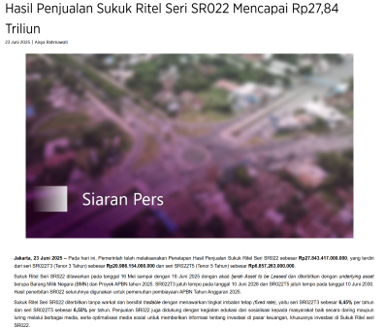
The results are significant. SR022 raised approximately Rp27.84 trillion and attracted 74,211 investors, while SR024 raised approximately Rp17.49 trillion and attracted 62,231 investors. Importantly, the investor base has not been limited to wealthy or older investors.
Millennials represented around half of the investors in both issuances, while women accounted for more than half of the investor base. Indonesia therefore provides an important case study for countries seeking to expand retail participation in bonds and sukuk.
The Rp1 Million Strategy: Making Sukuk Truly Retail
One of the strongest features of Indonesia's model is the low minimum investment.
Retail investors can purchase Sukuk Ritel from as little as Rp1 million, normally in multiples of Rp1 million. This dramatically changes the accessibility of government securities. The psychological impact of the minimum investment is important.
A minimum investment of Rp100 million or Rp250 million makes an investment product appear designed for wealthy individuals. A Rp1 million threshold communicates a completely different message:
"This investment is for ordinary people."
A young employee can invest Rp1 million. A small-business owner can invest Rp5 million. A family can allocate part of its savings into sukuk. A first-time investor can enter the capital market without committing a large amount of money. This approach helps create an investment habit.
The first investment may be small, but once investors become familiar with the product, they can increase their investment in subsequent issuances. Retail sukuk therefore becomes not just a fundraising instrument but also a gateway into the capital market. This is one of Indonesia's most important lessons where mass-market investment requires mass-market accessibility.
Digital Distribution Makes Sukuk Easier to Buy
Low investment requirements alone are not sufficient. Indonesia also made the purchasing process increasingly digital.
The retail government securities programme allows investors to register, order and pay through appointed distribution partners. The government describes the process through four main stages including registration, ordering, payment, and confirmation/settlement. This is especially important in a country consisting of thousands of islands spread across a vast geographical area. Digital distribution enables investors in both major cities and smaller communities to participate without visiting physical branches or securities firms.
Indonesia consists of thousands of islands and has a very large population spread across major cities and smaller communities. A physical-only distribution model would make it difficult and expensive to reach millions of potential investors. Digital distribution changes the economics.
A potential investor no longer needs to visit a securities office to understand or purchase a government sukuk. The product can be introduced through a bank or financial application that the investor already uses.
This creates a powerful combination:
Low minimum investment + mobile access + trusted financial institutions = mass-market distribution.
Digitalisation also allows financial institutions to communicate with customers more effectively. Investors can receive notifications when a new sukuk is available, compare products, complete transactions and receive information about maturity and reinvestment.
For younger generations in particular, this makes government securities more consistent with the way they already manage their finances.
Simple Products for Different Investor Needs
Indonesia has also avoided relying on a single retail sukuk structure.
Sukuk Ritel provides investors with a relatively straightforward, tradable retail investment product, while Sukuk Tabungan offers a savings-oriented alternative that is generally non-tradable but includes features such as early redemption.
This product variety allows investors to select instruments that align with their financial objectives.
For example:
• Investors seeking flexibility may prefer tradable retail sukuk.
• Longer-term savers may prefer a savings-oriented structure.
• Conservative investors may value government backing and predictable returns.
Providing choice broadens the market and accommodates different investor segments.
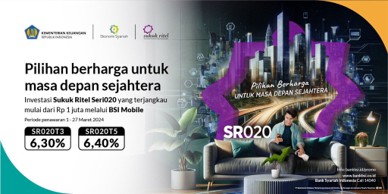
Another example, SR020 offered fixed annual returns of 6.30% for the three-year series and 6.40% for the five-year series, with a minimum investment of Rp1 million.
Sukuk Tabungan has a different structure and is generally non-tradable, while offering features such as early redemption. This gives investors different choices depending on their investment objectives.
Turning Issuance into Investor Acquisition
A key lesson from Indonesia is that success should not be measured solely by funds raised. The success of Indonesia's programme can be seen in the demographics of its investors. SR022 raised approximately Rp27.84 trillion from 74,211 investors. Millennials represented 49.78% of the investor base, while women represented 56.94%.
SR024 subsequently raised approximately Rp17.49 trillion from 62,231 investors. Millennials represented 50.75%, while women represented 57.16%. The issuance also attracted 20,297 investors who were new to retail Islamic government securities.
These figures are important because they show that retail sukuk can reach demographics beyond traditional fixed-income investors.
The objective should therefore not simply be:
"How much money can this issuance raise?"
A more important question is:
"How many new investors can this issuance create?"
This changes the government's strategy. Every issuance becomes an opportunity to acquire new customers, educate them and encourage them to participate in future issuances. The ultimate objective is to build a permanent retail investor base.
Creating Repeat Investors
A mature retail sukuk market does not depend entirely on continuously finding new investors. It also encourages existing investors to reinvest. This is particularly important when sukuk mature.
During the SR024 offering, approximately Rp6.33 trillion, or 39.88%, of the Rp16.95 trillion SR018T3 maturity amount was reinvested into SR024.
This demonstrates the potential for a powerful cycle:
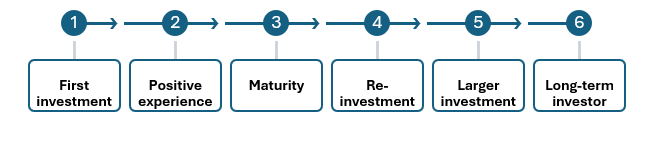
Once a person understands how retail sukuk works, the barriers to subsequent purchases become much lower.
This means the government and distribution partners should treat investors as long-term customers rather than one-off buyers.
At maturity, the investor should be presented with a simple option:
"Your sukuk has matured. Would you like to reinvest in the next available sukuk?"
Making reinvestment easy can significantly reduce customer acquisition costs while increasing the stability of the retail investor base.
Beyond Product Design: Why Indonesia's Ecosystem Works
While product features are important, Indonesia's success is also supported by broader ecosystem factors.
These include:
• Continuous retail government securities issuances over many years.
• Strong government commitment to domestic investor participation.
• Extensive distribution networks involving banks and financial institutions.
• Growing digital banking and fintech adoption.
• Ongoing public education and awareness campaigns.
• Strong familiarity with Islamic finance among Indonesian consumers.
Together, these factors create an environment where retail sukuk participation becomes normal rather than exceptional.
Understanding the Risks
Although retail sukuk offer attractive features, investors should understand that no investment product is entirely risk-free.
Key considerations include:
Inflation Risk; If inflation rises significantly, real purchasing power may decline even when investors continue receiving periodic returns.
Liquidity Risk; While some retail sukuk are tradable, liquidity levels may vary. Investors may not always be able to sell securities immediately at their preferred price.
Reinvestment Risk; Future issuances may offer lower returns than previous investments, affecting long-term income expectations.
Opportunity Cost; Investors must compare sukuk returns against other savings and investment alternatives available in the market.
Digital Fraud and Scam Risk; As digital distribution expands, investor education regarding cybersecurity and fraud prevention becomes increasingly important.
Including these considerations helps investors make informed decisions while enhancing the credibility of retail investment programmes.
Why Millennials and Women Matter
One of the most intriguing aspects of Indonesia's programme is the strong participation from millennials and women.
Several factors may contribute to this trend:
• Mobile-based investment processes align with younger investors' preferences.
• Small minimum investment amounts reduce entry barriers.
• Government-issued instruments provide a sense of security for first-time investors.
• Digital marketing and social media improve awareness.
• Regular issuance programmes encourage long-term participation.
The lesson for policymakers and market institutions is clear: retail investors cannot be treated as a single group. Different demographics require different communication channels and engagement strategies.
How Indonesia Compares with Other Retail Bond Markets
Many countries have introduced retail government securities programmes.
For example:
• Singapore has successfully developed the Singapore Savings Bond programme targeted at retail investors.
• Japan has long offered retail government bonds to encourage household participation in government financing.
• Malaysia has introduced various retail-oriented investment products, although retail participation in bonds and sukuk remains relatively limited compared with institutional participation.
Indonesia's achievement stands out because it combines accessibility, digitalisation, large-scale investor acquisition, and strong reinvestment behaviour within a single integrated framework.
What Malaysia Can Learn from Indonesia
Malaysia possesses one of the world's most sophisticated Islamic capital markets and a well-established sukuk ecosystem.
The challenge is not market capability but retail participation.
Indonesia's experience suggests several opportunities:
I. Lower Entry Barriers
Selected retail sukuk programmes could adopt smaller minimum investment sizes to attract first-time investors.
II. Maintain a Mobile-First Experience
Investors should be able to subscribe, monitor investments, receive distributions, and manage maturities through familiar digital platforms.
III. Leverage Existing Distribution Networks
Banks, investment platforms, and financial technology providers can serve as distribution partners without requiring new physical infrastructure.
IV. Simplify Investor Communication
Retail investors are less interested in technical terminology and more interested in practical questions:
• How much can I invest?
• What return can I expect?
• When will I receive payments?
• How long is my money invested?
• How do I buy it?
V. Focus on Repeat Investors
The goal should not simply be successful issuances. It should be the development of a loyal retail investor community that participates repeatedly over time.
Conclusion
Indonesia's retail sukuk programme demonstrates that the biggest obstacle to retail participation is often not a lack of investor interest. Rather, it is accessibility, simplicity, awareness, and convenience.
By combining a Rp1 million minimum investment, digital distribution, government credibility, broad distribution partnerships, and effective reinvestment strategies, Indonesia has created a model that has attracted tens of thousands of retail investors and generated substantial fundraising success.
The results are compelling. SR022 attracted more than 74,000 investors and raised Rp27.84 trillion, while SR024 attracted more than 62,000 investors and raised Rp17.49 trillion. Younger investors and women represented a significant share of participation, while substantial amounts were reinvested from maturing securities.
The most important lesson is therefore not simply how Indonesia sells sukuk. It is how Indonesia makes investing in sukuk feel normal and accessible to ordinary citizens.
For Malaysia and other countries seeking to expand their retail bond and sukuk markets, the blueprint is clear by start small, make it digital, keep it simple, distribute it widely and turn first-time investors into repeat investors.
If governments can successfully achieve these five objectives, retail sukuk can move beyond being a specialist Islamic-finance product and become a mainstream household investment instrument.
Indonesia did not simply create a successful retail sukuk product. It built a retail investor ecosystem. For Malaysia and other countries seeking to expand retail participation in bonds and sukuk, the blueprint is increasingly clear:
Start small. Make it digital. Keep it simple. Educate continuously. Distribute widely. Convert first-time investors into long-term participants. If these principles are successfully implemented, retail sukuk can move beyond being a niche Islamic finance instrument and become a mainstream household investment product that broadens financial inclusion and deepens domestic capital markets.
Sources and References
- Directorate General of Financing and Risk Management (DJPPR) Press Release, "Hasil Penjualan Sukuk Ritel Seri SR022 Mencapai Rp27,84 Triliun" (June 2025), Ministry of Finance of Indonesia
- Directorate General of Financing and Risk Management (DJPPR) Press Release, "Hasil Penjualan Sukuk Ritel Seri SR024 Mencapai Rp17,49 Triliun" (April 2026), Ministry of Finance of Indonesia.
- Directorate General of Financing and Risk Management (DJPPR) Official SR024 sales result announcement from DJPPR (April 2026), Ministry of Finance of Indonesia.
- Directorate General of Financing and Risk Management (DJPPR) DJPPR announcement, "Rencana Penjualan Sukuk Ritel Seri SR020T3 dan Seri SR020T5" (February 2024), Ministry of Finance of Indonesia.
- Securities Commission Malaysia, Catalysing MSME and MTC Access to the Capital Market: 5-Year Roadmap (2024 to 2028).
Disclaimer
The information contained in this report is prepared from data believed to be correct and reliable at the time of issuance of this report. While every effort is made to ensure the information is up-to-date and correct, the Company does not make any guarantee, representation or warranty, express or implied, as to the adequacy, accuracy, completeness, reliability or fairness of any such information contained in this report and accordingly, neither the Company nor any of its affiliates nor its related persons shall not be liable in any manner whatsoever for any consequences (including but not limited to any direct, indirect or consequential losses, loss of profits and damages) of any reliance thereon or usage thereof.
YOU MAY ALSO LIKE

ARTICLE
Nov 11, 2026
|
12 min read
ARTICLE
Nov 05, 2026
|
3 min read
ARTICLE
Nov 05, 2026
|
3 min read
ARTICLE
Oct 26, 2026
|
2 min read