


BIX ARTICLE
Surging bond yields reveals Trump's dilemma
Aug 13, 2026
|
5 min read
Featured Posts
Social Bonds Illustrative Use-Of-Proceeds Case Studies Coronavirus
Jul 06, 2020
|
2 min read
Sustainable Banking Network (SBN) Creating Green Bond Markets
Jul 06, 2020
|
2 min read
Why is Inflation Making a Big Comeback After Being Absent for Decades in the U.S.?
Mar 24, 2022
|
7 min read
SC issues Corporate Governance Strategic Priorities 2021-2023
Mar 29, 2022
|
3 min read
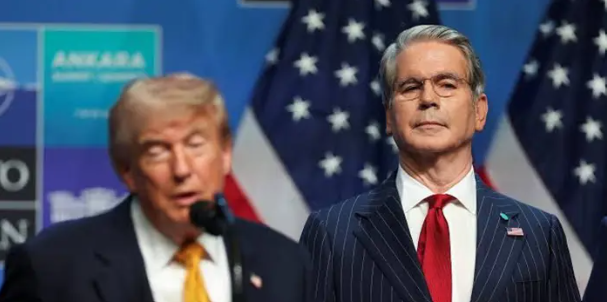
In its simplest framing, President Donald Trump is obsessed with the Federal Reserve (Fed) lowering its policy rate, while Treasury secretary Scott Bessent’s long-standing focus is the 10-year Treasury yield.
Of course, both want lower short and long-term borrowing costs, and Trump has broadened his focus on lower borrowing costs to longer-dated rates this year.
In an ideal world of low or slowing inflation, these goals are not necessarily incompatible.
But the economic, policy and geopolitical environment is far from ideal.
A more dovish Fed than markets expect may please Trump, but could also push the 10-year yield higher by reviving inflation concerns – precisely the outcome Bessent wants to avoid.
Yet for the 10-year yield not to rise much further – or, better still for Bessent, to reverse course – the Fed may have to bare its inflation-fighting talons and raise rates.
One can only imagine Trump’s reaction, especially in the run-up to the November mid-term elections, in which his party is already expected to struggle.
Markets aren’t pricing in any rate cuts, and even Trump accepts that surging oil prices resulting from the Iran war mean the Fed has to remain extra vigilant on price stability.
Inflation has been above the Fed’s 2% target for more than five years.
Energy shocks since the United States-Iran war began at end-February and serious questions about the Fed’s inflation-fighting credibility have rattled the bond market.
Those questions have intensified since Kevin Warsh replaced Jerome Powell as chair at end-May.
Investor concerns
The Wall Street Journal reported last week that Trump has called Warsh repeatedly since he became Fed chair.
Trump on Monday played that down, telling reporters: “I’ve only spoken to him one time briefly, a few days ago. Just a conversation.”
That is unlikely to assuage investor concerns about Warsh’s stance on inflation or the Fed’s independence.
Doubts about Warsh’s willingness to raise rates to curb inflation – and even about his commitment to the 2% target itself – have pushed the 30-year Treasury yield above 5.20%, its highest level since 2007.
On Monday, the real yield on 30-year Treasury Inflation-Protected Securities rose further above 3%, to its highest level since 2008.
Mortgage rates, which are priced off the 30-year yield, are at their highest level in over a year.
10-year yield at 5% soon?
Those concerns are most visible at the long end of the curve.
But for Bessent, the more politically salient benchmark is the 10-year yield.
The 10-year yield has reached 4.75%, an 18-month high. Bessent previously said he wanted the yield to have a “3” handle, meaning below 4%.
War, energy shocks, a yawning federal budget deficit, and market uncertainty over Warsh’s overhaul of the Fed suggest that won’t happen anytime soon.
Indeed, a move to 5% now looks like the more immediate risk.
That may have factored into Bessent’s decision to intervene in the currency market to support the Japanese yen.
Washington’s concern about further upward pressure on Treasury yields helps explain the rare coordinated action with Japan and the unusual use of a seldom-touched Fed facility.
If Tokyo is to support the yen, Washington would prefer it does so without selling any of its US$1.14 trillion US Treasuries it holds.
On the domestic front, a surprise decline in July non-farm payrolls, downward revisions to previous months, and below-forecast inflation prints have trimmed Fed rate-hike expectations.
Only two quarter-percentage-point hikes over the next year are fully priced into interest rate futures markets, down from three a few weeks ago.
The July consumer price index report due yesterday is the next major hurdle for rates markets. A strong number could bring a September rate hike into full view, easing upward pressure at the longer end of the bond market.
A downside surprise could take a Fed move next month off the table completely, but stoke fears that the Fed is falling behind the curve, pushing the 10-year yield closer to 5%.
Neither outcome offers much comfort to Trump or Bessent. But one may prove less painful than the other. — Reuters
Jamie McGeever is a columnist for Reuters. The views expressed here are the writer’s own.
Disclaimer
YOU MAY ALSO LIKE

ARTICLE
Oct 21, 2026
|
3 min read
ARTICLE
Oct 19, 2026
|
6 min read
ARTICLE
Oct 18, 2026
|
5 min read
ARTICLE
Oct 16, 2026
|
5 min read