


BIX ARTICLE
The differences between crypto, stablecoin and CBDC
Jan 26, 2026
|
3 min read
Featured Posts
Social Bonds Illustrative Use-Of-Proceeds Case Studies Coronavirus
Jul 06, 2020
|
2 min read
Sustainable Banking Network (SBN) Creating Green Bond Markets
Jul 06, 2020
|
2 min read
Why is Inflation Making a Big Comeback After Being Absent for Decades in the U.S.?
Mar 24, 2022
|
7 min read
SC issues Corporate Governance Strategic Priorities 2021-2023
Mar 29, 2022
|
3 min read
Cryptocurrencies (like Bitcoin and Ethereum) are digital-native assets on public blockchains. There is no issuer, no sovereign backing. Their value is determined entirely by scarcity, network belief and speculative demand. They overcome fears of censorship, a lack of trust in institutions and governments, currency debasement and asset confiscation.
Cryptocurrencies meet the above objectives as they are hard to censor. They are global assets that trade without the permission of any authority and there is no counterparty risk when held on a self-custodial basis. Their weaknesses include extremely volatility, the absence of a real "price anchor", poor performance as a unit of account and limited real-economy usage.
Stablecoins are private digital representations of flat currency. They are pegged at 1:1 to USD or other fiat currencies, and are backed by cash or short-term government securities. Yes, some are backed by opaque reserves, which should be avoided.
The usefulness of stablecoins is that they act as a fast, widely used and low-cost digital payment and settlement solution, offering price stability and a bridge between crypto and the real economy. Their weaknesses are that stablecoins are effectively pegged to fiat currencies, with counterparty risk and regulatory exposure.
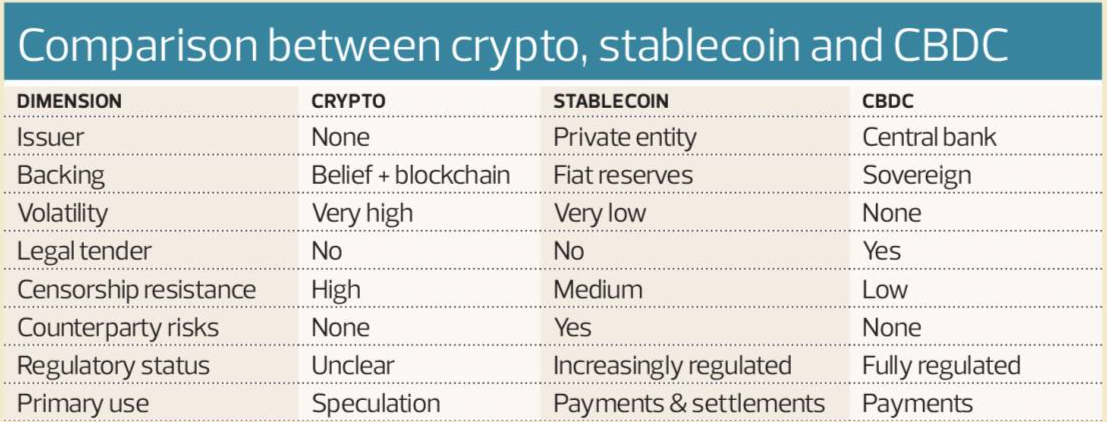
Central bank digital currencies (CBDCs) are the digital form of sovereign money, issued directly by the central bank, like cash. They effectively modernise payment systems, maintain monetary sovereignty and improve financial inclusion.
Their advantages include no credit risk, legal tender status and completely stable prices. Their disadvantages are the same as holding cash or money in the bank: privacy concerns, reliance on trust in governments and banks, and fiat debasement.
In short, cryptos, stablecoins and CBDCs are not competing versions but occupy different layers of the monetary stack. CBDCs are the base layer as state money; stablecoins are for settlements (private but regulated); and cryptocurrencies are the speculative and alternative asset class. In other words, CBDCs formalise trust in the state, stablecoins borrow trust from existing money, and cryptocurrencies replace trust in institutions with blockchain technology. It is likely that they will each have a role, one layering on top of the other. CBDCs will co-exist with cash and bank deposits, stablecoins will be regulated for more efficient payments and settlements, and cryptocurrencies will remain volatile as a niche hedging instrument.
Disclaimer
The information provided in this report is of a general nature and has been prepared for information purposes only. It is not intended to constitute research or as advice for any investor. The information in this report is not and should not be construed or considered as an offer, recommendation or solicitation for investments. Investors are advised to make their own independent evaluation of the information contained in this report, consider their own individual investment objectives, financial situation and particular needs and should seek appropriate personalised financial advice from a qualified professional to suit individual circumstances and risk profile. The information contained in this report is prepared from data believed to be correct and reliable at the time of issuance of this report. While every effort is made to ensure the information is up-to-date and correct, Bond and Sukuk Information Platform Sdn Bhd (“the Company”) does not make any guarantee, representation or warranty, express or implied, as to the adequacy, accuracy, completeness, reliability or fairness of any such information contained in this report and accordingly, neither the Company nor any of its affiliates nor its related persons shall not be liable in any manner whatsoever for any consequences (including but not limited to any direct, indirect or consequential losses, loss of profits and damages) of any reliance thereon or usage thereof.
YOU MAY ALSO LIKE

ARTICLE
Jan 26, 2026
|
7 min read
ARTICLE
Jan 26, 2026
|
3 min read
ARTICLE
Jan 21, 2026
|
4 min read
ARTICLE
Jan 20, 2026
|
5 min read