


BIX ARTICLE
Singapore Savings Bonds: How Singapore Made Government Bonds Simple for Retail Investors
Oct 09, 2026
|
16 min read
Featured Posts
Social Bonds Illustrative Use-Of-Proceeds Case Studies Coronavirus
Jul 06, 2020
|
2 min read
Sustainable Banking Network (SBN) Creating Green Bond Markets
Jul 06, 2020
|
2 min read
Why is Inflation Making a Big Comeback After Being Absent for Decades in the U.S.?
Mar 24, 2022
|
7 min read
SC issues Corporate Governance Strategic Priorities 2021-2023
Mar 29, 2022
|
3 min read
Introduction
Government bonds are traditionally regarded as one of the safer investment instruments available in a capital market. Yet, for many ordinary investors, buying and holding a government bond can appear complicated. Investors may need to understand bond prices, yields, maturity dates, secondary-market trading and interest-rate risk. In some markets, relatively high minimum investment amounts and the need to use specialised investment accounts can also discourage smaller investors.
Singapore took a different approach when it launched the Singapore Savings Bonds (SSB) programme in 2015. Rather than simply giving individuals access to conventional government securities, the Monetary Authority of Singapore (MAS) designed a product specifically around the needs of retail investors: safety, simplicity, long-term savings and flexibility.
The SSB has a maturity period of up to 10 years and investors may redeem before maturity at par (subject to the programme's redemption procedures) and starts from a minimum investment of S$500, and allows investors to redeem before maturity at par value, with a small administrative redemption fee applicable under the programme. The interest rate increases over time, encouraging longer-term holding.
The programme provides an interesting case study for Malaysia. Malaysia already has a developed government bond or Malaysian Government Securities (MGS) and Government Investment Issues (GII). Malaysia had a regulatory framework intended to give retail investors direct access to bonds and sukuk. The key question is therefore not whether Malaysia can issue bonds to retail investors, but whether the Malaysian market can make bond and sukuk investment as simple, accessible and familiar to ordinary savers as other retail investment products.
This article examines how Singapore's Savings Bonds work, why the product has been accepted by retail investors, what impact it has had, and what lessons Malaysia could consider in developing its own retail bond and sukuk market.
1. Why Singapore Created Savings Bonds
The SSB programme was launched in 2015 with a specific objective is to provide individuals with a safe, long-term and flexible savings product. This is important because conventional government bonds are not necessarily designed around the needs of small investors. A conventional bond may have a fixed maturity and can fluctuate in market value when interest rates change. An investor who needs to sell before maturity may therefore receive more or less than the amount originally invested.
Singapore addressed this problem by designing flexibility directly into the product. The SSB is backed by the Singapore Government, and investors can redeem their bonds at the amount invested, together with accrued interest, without being exposed to secondary-market price fluctuations because redemption is made at the principal amount invested. Investors also do not have to decide at the beginning whether they want to invest for two, five or ten years. They can redeem early if they need the money.
This design effectively combines some of the characteristics that retail investors value in both savings and investment products:
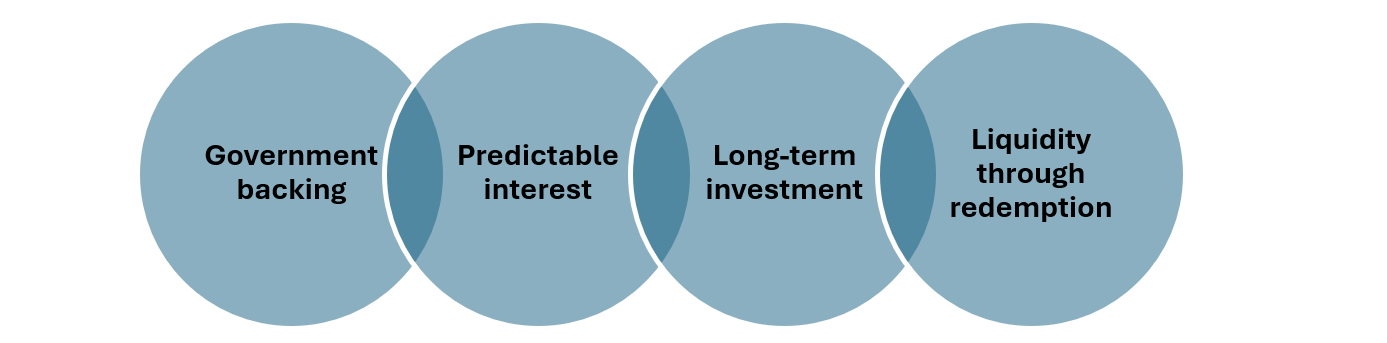
That simplicity is one of the most important reasons why the SSB is relevant as a policy case study.
2. How the Singapore Savings Bonds Work
The SSB has several features specifically designed for individual investors.
Low minimum investment
Investors can start with just S$500, with additional investments made in multiples of S$500. The investment limit for an individual was subsequently increased to S$200,000 across all Savings Bonds. A low minimum denomination is important because it removes one of the traditional barriers to bond investment.
For example, a person with S$5,000 in savings can allocate S$500, S$1,000 or S$2,000 to Savings Bonds without needing to commit a large amount of capital. This makes the product fundamentally different from the traditional perception of bonds as instruments mainly for institutional investors or wealthy individuals.
Ten-year maturity
Each Savings Bond has a tenor of approximately 10 years. However, the investor is not locked in for the entire ten years. The long maturity allows investors to plan for long-term savings, retirement or other financial objectives, while the redemption feature provides flexibility.
Step-up interest
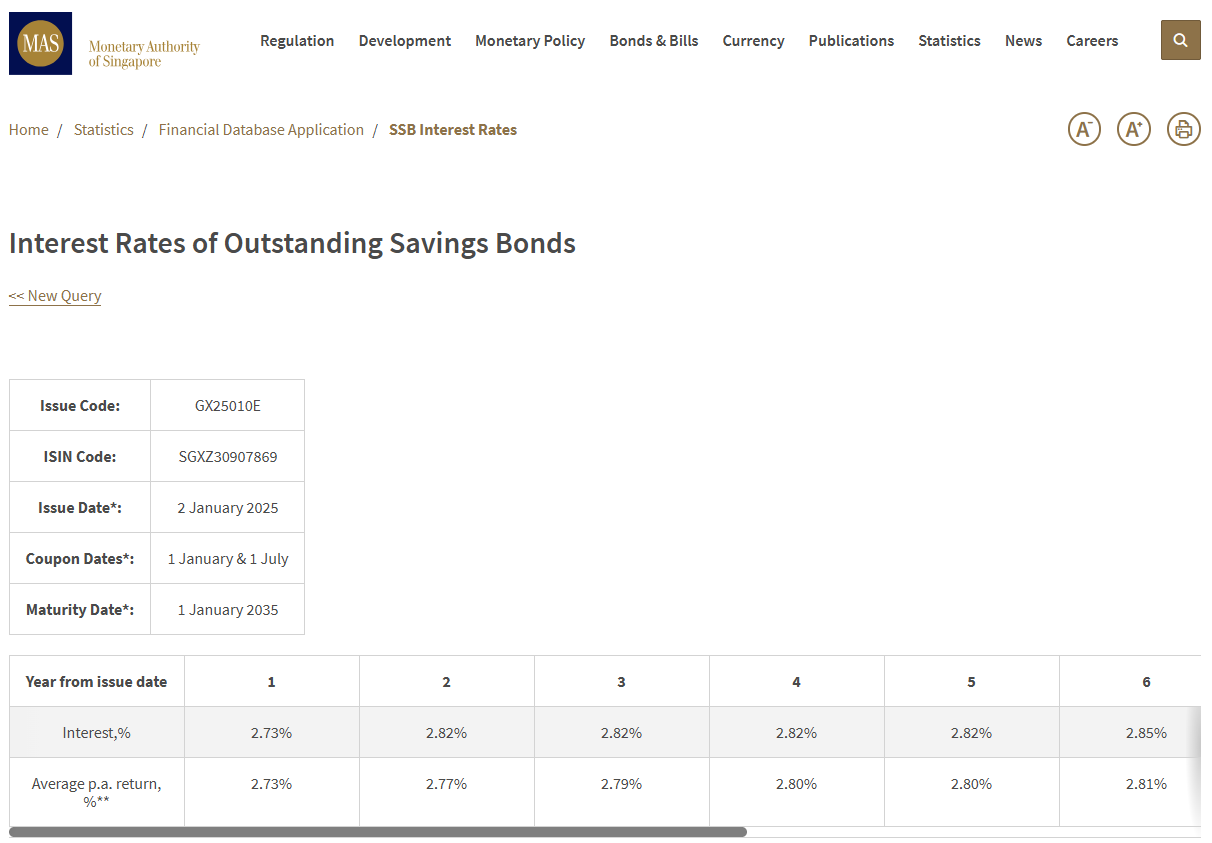
One of the most distinctive features is the step-up interest structure. Instead of paying the same coupon throughout the ten-year period, the interest rate increases the longer the investor holds the bond.
The mechanism is designed to reward investors who remain invested for longer periods. MAS explains that the design is to broadly track the prevailing long-term Singapore Government Securities yield curve at issuance, while preserving capital and redemption flexibility at the time the bond is issued.
The longer you save, the higher your annual interest becomes. That is much easier for many retail investors to understand than constantly monitoring bond prices and yields in the secondary market.
Semi-annual interest payments
Interest is paid every six months. This gives investors a predictable cash flow while maintaining the long-term nature of the product.
Early redemption
Perhaps the most important retail-friendly feature is the ability to redeem the investment monthly without an early-redemption penalty. Investors can therefore treat the SSB as a relatively flexible component of their savings rather than an investment that must remain untouched until maturity.
3. The Investment Mechanism
The SSB model can be simplified into a straightforward process:
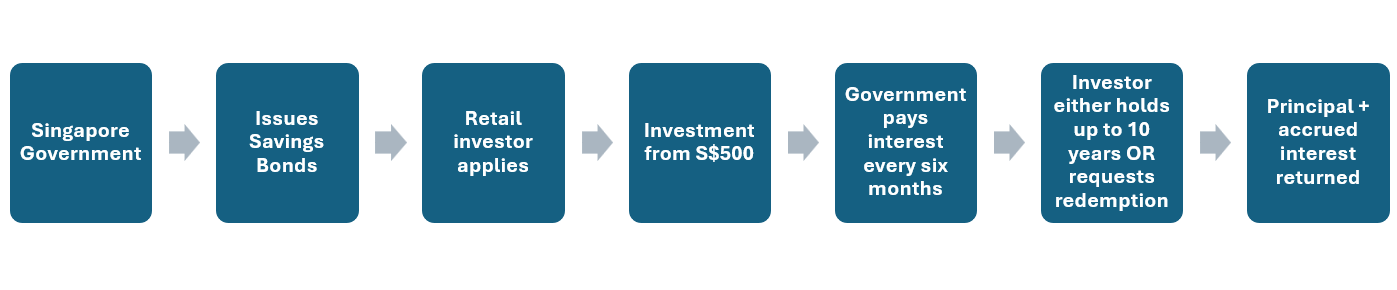
The bonds are issued monthly. The first SSB issue was scheduled for December 2015, with a minimum denomination of S$500 and eligibility restricted to individuals. At the beginning of the programme, investors could apply through participating banks such as DBS/POSB, OCBC and UOB.
The product therefore does not require investors to become sophisticated bond traders. The SSB is fundamentally designed as a savings and investment product, rather than as a trading product.
4. Investor Acceptance: Did the Model Work?
The most important evidence of the SSB's success is the growth of its investor base. In 2022, MAS stated that the programme had been well received and had grown steadily. At the beginning of 2022, approximately 120,000 individuals held more than S$5.7 billion of Savings Bonds. MAS cited this positive reception as a reason for maintaining the programme. More recent SSB issues have experienced fluctuating demand in line with the changing interest-rate environment. Following the global rate hikes of 2022-2024, SSB demand increased significantly as retail investors sought relatively low-risk fixed income investments. As interest rates normalize, demand levels may moderate, demonstrating the sensitivity of retail participation to prevailing yields.
This is significant because it demonstrates that government bonds do not necessarily have to be positioned as complex capital-market products. They can be positioned as an accessible savings instrument for ordinary households.
Individual issues can also experience varying levels of demand depending on interest rates and investor preferences. For example, an SSB issued in January 2025 had a maximum offering amount of S$600 million and received S$326.3 million in applications, of which S$309.7 million was within the individual allotment limits and was allotted.
This illustrates an important point: success should not be measured only by whether every issue is oversubscribed. A more meaningful measure is whether the programme consistently attracts individuals and provides a durable channel for household participation in government securities. The growth to approximately 120,000 individual holders and S$5.7 billion in holdings demonstrates that the product achieved meaningful retail penetration.
5. Why the Product Is Attractive to Retail Investors
The SSB's success can be attributed to several design principles.
5.1 Safety
The bonds are backed by the Singapore Government.
For conservative investors, this provides an important psychological advantage. Investors do not need to analyse the financial statements of a corporate issuer or assess the probability of corporate default in the same way they would with corporate bonds.
5.2 Simplicity
The product can be explained using a few basic concepts:
- Invest from S$500.
- Receive interest every six months.
- Interest increases over time.
- Hold for up to ten years.
- Redeem when needed.
5.3 Flexibility
Investors can redeem without a penalty.
This is particularly important because retail investors often value liquidity more highly than institutional investors. A household may need access to its money because of an emergency, education expenses, housing costs or other financial needs.
The SSB allows the investor to retain flexibility without requiring the investor to sell the bond at a potentially unfavourable market price.
5.4 Predictability
The investor knows the interest schedule at the time of investment.
This is attractive to investors who prefer predictable income rather than the uncertainty associated with equity investments.
5.5 Low entry barrier
A S$500 minimum makes the product accessible to a much wider population than conventional wholesale bonds.
This is perhaps the most important lesson for other markets.
Retail participation is not only a regulatory issue; it is also a product-design issue.
6. What Makes the Singapore Model Different?
The SSB is not simply a smaller version of an ordinary government bond.
Singapore redesigned the product around retail-investor behaviour.
A traditional bond is generally built around:
Issuer → institutional investor → secondary market → maturity
The SSB is designed more like:
Government → individual saver → periodic interest → optional redemption
This distinction matters.
The product reduces the importance of secondary-market trading for the individual investor. Instead of telling investors:
“If you need your money before maturity, sell the bond in the secondary market.”
the SSB effectively says:
“If you need your money, redeem the bond.”
This removes a major source of complexity.
The investor does not have to understand duration, bond price volatility or bid-ask spreads simply to access the investment.
7. Lessons for Malaysia
The Singapore experience is particularly relevant because Malaysia already has a regulatory foundation for retail bonds and sukuk.
Securities Commission Malaysia (SC) launched the Malaysian retail bonds and sukuk framework in 2012 to provide retail investors with direct access to bonds and sukuk. Retail securities can be offered and traded through Bursa Malaysia or through appointed banks on an over-the-counter basis.
The framework has subsequently been expanded. Malaysia's framework includes investor-protection measures such as disclosure requirements, trustees and trust deeds, and mandatory credit ratings for retail bonds and sukuk offered by relevant issuers, subject to specified exemptions.
Lesson 1: Create a product specifically for retail investors
Malaysia could consider whether an existing government bond or sukuk is sufficient for retail investors, or whether a dedicated product could be created.
A possible Malaysian product could be structured as a:
Malaysia Savings Bond / Retail Savings Sukuk
with:
- RM500 or RM1,000 minimum investment;
- fixed returns;
- monthly or quarterly issuance;
- 5–10 year maturity;
- predictable income;
- periodic redemption;
- simple digital application.
Lesson 2: Make the investment journey simple
A Malaysian retail investor should ideally be able to go from:
“I have RM1,000 to invest” to “I own a government bond/sukuk”
with as few steps as possible. This could involve bank mobile applications, online investment platforms and a centralised digital interface. The simpler the journey, the greater the possibility of reaching younger investors and people who have never invested in bonds before.
Lesson 3: Use low denominations
Malaysia already allows exchange-traded retail bonds and sukuk with a minimum board size of RM1,000, according to the Securities Commission's retail-bond information.
However, a minimum denomination alone does not guarantee mass participation. The product also needs to be easy to understand, easy to purchase and regularly available.
Lesson 4: Consider a regular issuance calendar
Singapore issues Savings Bonds on a monthly basis. A predictable issuance calendar can help develop investor habits.
Instead of asking:
“When will the next retail bond be available?”
investors can know:
“There is a retail bond or sukuk opportunity every month.”
This can help turn bond investment from an occasional transaction into a regular savings behaviour.
Lesson 5: Use sukuk to broaden participation
Malaysia has a unique advantage that Singapore does not have to the same extent: one of the world's most developed sukuk markets.
A Malaysian retail savings product could therefore potentially be offered in both:
Conventional bond format and Shariah-compliant sukuk format. This could make the product relevant to a broader investor base.
Malaysia could potentially develop a retail savings sukuk with the same principles as the SSB:
low denomination + government credit quality + predictable returns + simple purchase + flexible redemption.
8. What Malaysia Should Not Copy Blindly
Despite the success of the Singapore model, Malaysia should not simply replicate it.
Singapore and Malaysia have different:
- market sizes;
- investor demographics;
- savings behaviour;
- financial-market structures;
- fiscal requirements;
- Islamic-finance ecosystems;
- digital-investment environments.
Instead, a retail bond or sukuk programme should form part of a diversified household investment portfolio. Investor education is therefore critical. Malaysia's own retail bond and sukuk framework recognises this by placing emphasis on investor education alongside disclosure and other investor-protection measures.
9. A Possible Malaysian Model
Based on the Singapore experience, Malaysia could consider a hypothetical Malaysia Retail Savings Bond/Sukuk with the following characteristics:
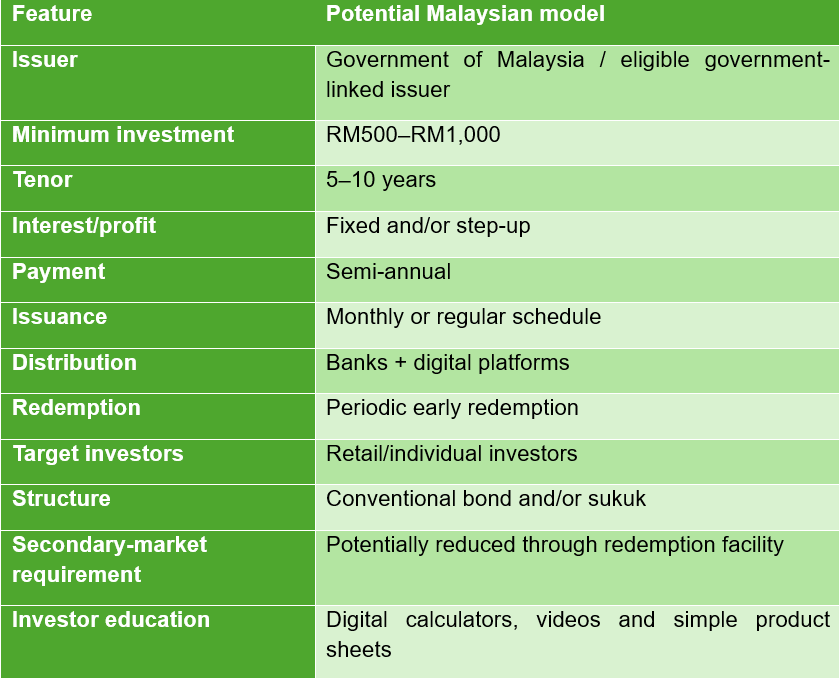
The most important innovation would not necessarily be the bond itself. It would be the combination of product design, distribution and investor education.
For example, a Malaysian investor could open a banking application, select “Retail Government Bond/Sukuk”, choose RM500, view the expected income over five years, read a one-page product summary and confirm the investment. The experience should feel closer to opening a fixed deposit than trading a sophisticated capital-market security.
10. Broader Impact on the Capital Market
The SSB model also demonstrates that retail bonds can have benefits beyond simply raising government funding.
Diversification for households
Retail investors gain access to an additional asset class between traditional deposits and higher-risk investments such as equities.
Development of investment culture
Regular exposure to fixed-income products can help households understand concepts such as maturity, coupon, yield and diversification.
Broader investor base
A larger retail investor base can diversify the ownership of government securities beyond institutional investors.
Capital-market participation
Retail investors who become familiar with government bonds may subsequently become more comfortable with corporate bonds, sukuk, bond funds and other fixed-income instruments.
This creates a potential “gateway effect”:
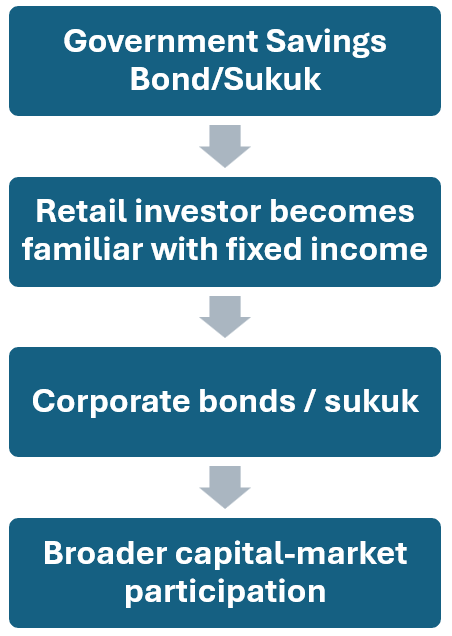
This is potentially one of the most important long-term benefits for Malaysia.
Key Takeaways for Malaysia
1. Malaysia Already Has the Foundation
Malaysia has:
- A developed government bond market (MGS and GII)
- A retail bonds and sukuk framework launched in 2012 by the Securities Commission
- Established distribution channels through Bursa Malaysia and appointed banks
- Investor-protection measures including disclosure, trustees, and credit ratings
2. Consider a Dedicated Retail Savings Product
Malaysia could create a Malaysia Retail Savings Bond / Retail Savings Sukuk with:
- Minimum investment of RM500–RM1,000
- Fixed and/or step-up returns
- 5–10 year maturity
- Semi-annual payments
- Monthly or regular issuance
- Periodic early redemption
- Digital application through banks and online platforms
- Both conventional and Shariah-compliant (sukuk) formats
An investor should be able to go from "I have RM1,000 to invest" to "I own a government bond/sukuk" with minimal steps, ideally through mobile banking apps and digital platforms.
4. Leverage Malaysia's Sukuk Expertise
Malaysia's world-leading sukuk market is a unique advantage. A retail savings sukuk could broaden participation among Shariah-conscious investors and differentiate Malaysia's offering.
5. Use Low Denominations and Regular Issuance
Low minimum investment alone is not enough. The product must also be easy to understand, easy to buy, and regularly available.
6. Do Not Copy Blindly
Malaysia should adapt, not replicate. Differences in market size, investor demographics, savings behaviour, fiscal requirements, and Islamic-finance ecosystems must be considered. The goal is not to channel all household savings into government securities, but to offer a diversified investment option alongside investor education.
7. Create a "Gateway Effect"
Familiarity with government savings bonds/sukuk can lead retail investors to explore corporate bonds, sukuk, bond funds, and other fixed-income instruments, broadening overall capital-market participation.
Lesson
Singapore's success was not just about issuing more retail bonds—it was about product design, distribution, and investor education working together. Malaysia can combine these principles with its existing bond-market infrastructure and global sukuk leadership to transform retail bonds and sukuk from a specialised capital-market product into a familiar component of household savings and investment.
Conclusion
Singapore's Savings Bonds demonstrate that the challenge of increasing retail participation in the bond market is not necessarily solved by simply allowing retail investors to buy existing wholesale securities.
The more important question is:
Can the bond be designed around the needs of an ordinary investor?
Singapore's answer was to create a product with four central characteristics:
Safe.
Simple.
Flexible.
Accessible.
The SSB programme has subsequently developed into a meaningful retail savings channel. By the beginning of 2022, approximately 120,000 individuals held more than S$5.7 billion in Savings Bonds, and MAS described the programme as well received and steadily growing.
Malaysia has an important advantage: it already possesses a sophisticated bond and sukuk market and a regulatory framework that provides retail investors with direct access to these instruments. The Securities Commission's framework also provides mechanisms for exchange and OTC distribution and incorporates investor-protection measures.
Therefore, Malaysia does not necessarily need to start from zero.
Instead, it could ask what elements of Singapore's retail model could be adapted to the Malaysian market.
A dedicated Malaysia Retail Savings Bond or Retail Savings Sukuk, with a low minimum investment, predictable returns, regular issuance, digital distribution and a simple redemption mechanism, could potentially bring fixed-income investing closer to ordinary Malaysians.
The biggest lesson from Singapore is therefore not simply “issue more retail bonds.”
It is:
Make bonds simple enough that ordinary people understand them, affordable enough that ordinary people can buy them, and flexible enough that ordinary people are comfortable holding them.
If Malaysia can combine those principles with its existing bond-market infrastructure and global strength in sukuk, retail bonds and sukuk could move from being a specialised capital-market product to becoming a more familiar component of household investment and savings.
Sources and References
- Monetary Authority of Singapore, Singapore Savings Bonds.
- Securities Commission Malaysia, Comparison between bonds and sukuk traded on the exchange and OTC.
- Securities Commission Malaysia, Phases of Retail Bonds and Sukuk Market.
- Monetary Authority of Singapore, Products for Individuals.
- Monetary Authority of Singapore, SSB FAQs.
- Monetary Authority of Singapore, SSB Overview.
- Monetary Authority of Singapore, Products for Individuals.
- Securities Commission Malaysia, Retail Bonds and Sukuk Market in Malaysia.
Disclaimer
This report has been prepared and issued by Bond and Sukuk Information Platform Sdn Bhd (“the Company”). The information provided in this report is of a general nature and has been prepared for information purposes only. It is not intended to constitute research or as advice for any investor. The information in this report is not and should not be construed or considered as an offer, recommendation or solicitation for investments. Investors are advised to make their own independent evaluation of the information contained in this report, consider their own individual investment objectives, financial situation and particular needs and should seek appropriate personalised financial advice from a qualified professional to suit individual circumstances and risk profile.
The information contained in this report is prepared from data believed to be correct and reliable at the time of issuance of this report. While every effort is made to ensure the information is up-to-date and correct, the Company does not make any guarantee, representation or warranty, express or implied, as to the adequacy, accuracy, completeness, reliability or fairness of any such information contained in this report and accordingly, neither the Company nor any of its affiliates nor its related persons shall not be liable in any manner whatsoever for any consequences (including but not limited to any direct, indirect or consequential losses, loss of profits and damages) of any reliance thereon or usage thereof.
YOU MAY ALSO LIKE

ARTICLE
Oct 09, 2026
|
16 min read
ARTICLE
Sep 24, 2026
|
9 min read
ARTICLE
Sep 07, 2026
|
8 min read
ARTICLE
Sep 02, 2026
|
4 min read