


BIX ARTICLE
How to Buy Bond and Sukuk for Retail Investors in Malaysia
Sep 07, 2026
|
8 min read
Featured Posts
Social Bonds Illustrative Use-Of-Proceeds Case Studies Coronavirus
Jul 06, 2020
|
2 min read
Sustainable Banking Network (SBN) Creating Green Bond Markets
Jul 06, 2020
|
2 min read
Why is Inflation Making a Big Comeback After Being Absent for Decades in the U.S.?
Mar 24, 2022
|
7 min read
SC issues Corporate Governance Strategic Priorities 2021-2023
Mar 29, 2022
|
3 min read
For many Malaysians, investing is often associated with shares, unit trusts, fixed deposits or property. Bonds and sukuk, however, are another important investment option that can provide regular income and help diversify an investment portfolio. Although the Malaysian bond and sukuk market is one of the largest and most developed in the region, many retail investors are still unfamiliar with how to access it.
The good news is that retail investors in Malaysia can invest directly in selected bonds and sukuk with an investment amount that can start from around RM1,000, depending on the product and distributor. The regulatory framework has also evolved to provide greater access to the bond and sukuk market for retail investors.
This article explains what bonds and sukuk are, where retail investors can find them, how to assess an investment, how to place an order and what risks investors should consider before investing.
Understanding Bonds and Sukuk
Bond is essentially a loan provided by an investor to an issuer. The issuer may be the Government, a government-related entity, a financial institution or a corporation. In return for providing the funds, the investor normally receives periodic interest payments, known as coupon payments, and repayment of the principal at maturity.
For example, an investor who purchases RM10,000 of a bond with a 4% annual coupon could receive RM400 per year in coupon income, subject to the bond's payment terms. If the bond is held until maturity and the issuer does not default, the investor would normally receive the RM10,000 principal back.
Sukuk is a Shariah-compliant investment certificate that represents an interest or beneficial ownership in underlying assets, projects, services or investment activities, depending on its structure. Instead of conventional interest, investors receive distributions or profit payments according to the relevant Shariah structure.
For a retail investor, the practical characteristics of bonds and sukuk can be similar: investors provide financing to an issuer, receive periodic income according to the terms of the security and may receive their principal at maturity, subject to the issuer fulfilling its obligations.
Bonds and sukuk can therefore be attractive to investors looking for regular income, portfolio diversification and potentially lower volatility than equities. However, they are not risk-free investments. The issuer can potentially default, and the market price can fall before maturity.
Who Can Buy Bonds and Sukuk in Malaysia?
Historically, the Malaysian bond and sukuk market was primarily accessible to institutional and sophisticated investors because of relatively high investment denominations. The Securities Commission Malaysia subsequently introduced and liberalised frameworks to facilitate greater participation by retail investors.
Retail investors can now access selected retail bonds and sukuk as well as certain corporate bonds and sukuk distributed under the relevant retail frameworks. BIX Malaysia explains that retail investors can access selected bonds and sukuk at denominations as low as RM1,000.
However, investors should not assume that every bond or sukuk available in Malaysia can be purchased with RM1,000. Eligibility, denomination, distribution arrangements and investor requirements depend on the particular security.
One important route is the Seasoned Bond and Sukuk Framework, under which certain corporate bonds or sukuk originally issued to sophisticated investors can subsequently become available to retail investors in the secondary market if they meet the applicable eligibility requirements. BIX notes that eligible seasoned bonds can be purchased by both sophisticated and retail investors through eligible distributors.
Therefore, the first step for a retail investor is not simply to find a bond with an attractive coupon. The investor must first determine whether the security is actually available to retail investors.
Where Can Retail Investors Find Bonds and Sukuk?
One of the most useful resources for Malaysian retail investors is the Bond and Sukuk Information Exchange (BIX Malaysia). BIX provides centralised information on Malaysia's bond and sukuk market, including security information, issuer information, ratings, transaction information and market data.
BIX also provides tools such as a bond and sukuk search function and a calculator that can help investors understand prices and yields. Investors should use BIX as an information and research platform, rather than assuming that every security displayed on BIX can be purchased directly through the website.
For retail products, investors generally need to purchase through an eligible distributor on BIX Malaysia website, such as an appointed financial institution or other authorised intermediary, depending on the particular product.
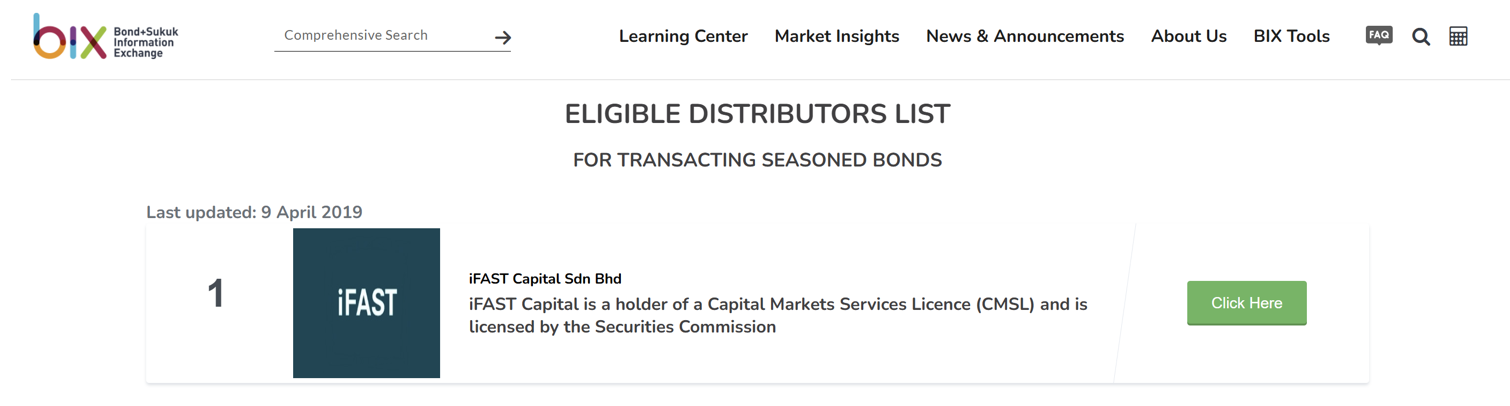
The purchasing process can therefore be summarised as:
Research → Contact eligible distributor → Compare bonds/sukuk → Open/activate required investment account → Place order → Receive confirmation → Monitor investment
Simple Example for a Malaysian Retail Investor
Consider an investor with RM20,000 who wants to invest in a corporate sukuk.
Suppose the sukuk has:
Face value: RM20,000 or greater
Investment: RM20,000
Profit rate: 4.50% per annum
Tenure: 5 years
Payment frequency: Semi-annual
If the investment is made at face value and the terms remain unchanged, the annual profit distribution would be approximately:
RM20,000 × 4.50% = RM900 per year
With semi-annual payments, this would be approximately:
RM900 ÷ 2 = RM450 every six months
At maturity, the investor would normally expect repayment of the RM20,000 principal, provided the issuer fulfils its obligations and there are no circumstances under the terms that affect repayment.
If the investor sells the sukuk before maturity, however, the selling price could be higher or lower than RM20,000. It is crucial to emphasise that the purchased yield to maturity (YTM) represents the total annualised return the buyer earns if the bond is held until maturity, and it is not a fixed profit rate or interest rate on the principal. Conversely, if the prevailing market selling yield rises above this purchased YTM, the investor will incur a capital loss should they choose to sell the bond before its maturity date. This example demonstrates why investors should consider both income and capital value when investing in bonds and sukuk.
A Practical Checklist Before Buying
Before placing an order, a retail investor should be able to answer the following questions:
- Who is the issuer?
- Is it a government, government-related or corporate issuer?
- Is the security conventional or sukuk?
- What is the credit rating?
- What is the maturity date?
- What is the coupon or profit rate?
- What is the current yield to maturity?
- What is the current market price?
- What is the minimum investment amount?
- Does this bond issuance feature a call option (issuer redemption right) prior to its stated maturity date?
- Is it available to retail investors?
- Who is the eligible distributor?
- How frequently are payments made?
- Can I sell it before maturity?
- How liquid is the secondary market?
- What are the transaction costs?
- What happens if the issuer experiences financial problems?
- For sukuk, what is the underlying Shariah structure?
- Can I afford to keep the money invested until maturity?
Conclusion
Buying bonds and sukuk in Malaysia is no longer limited to large institutional investors. The development of retail bond and sukuk frameworks has created opportunities for individuals to participate in the Malaysian fixed-income market, with selected investments available from denominations such as RM1,000.
For a new investor, the process can be relatively straightforward: define an investment objective, research the market, identify a retail-eligible bond or sukuk, assess the issuer and credit rating, compare the price and yield, check the maturity and risks, identify an eligible distributor, and then place the order.
The most important lesson is that investors should not buy a bond or sukuk simply because its coupon or profit rate looks attractive. A higher return can reflect higher credit, liquidity or structural risk.
Instead, retail investors should evaluate the complete investment proposition: who is borrowing the money, why they are borrowing it, how much they will pay, when they will repay it, what the security is worth today, and what could happen if the investor needs to sell before maturity.
For Malaysian retail investors beginning their fixed-income journey, BIX Malaysia is a useful starting point because it provides centralised bond and sukuk information, educational resources and tools that can help investors research securities before approaching the relevant distributor.
Ultimately, successful bond and sukuk investing is not simply about finding the highest yield. It is about finding the right balance between return, credit quality, maturity, liquidity and risk for the investor's financial objectives.
Disclaimer
The information contained in this report is prepared from data believed to be correct and reliable at the time of issuance of this report. While every effort is made to ensure the information is up-to-date and correct, the Company does not make any guarantee, representation or warranty, express or implied, as to the adequacy, accuracy, completeness, reliability or fairness of any such information contained in this report and accordingly, neither the Company nor any of its affiliates nor its related persons shall not be liable in any manner whatsoever for any consequences (including but not limited to any direct, indirect or consequential losses, loss of profits and damages) of any reliance thereon or usage thereof.
YOU MAY ALSO LIKE

ARTICLE
Oct 09, 2026
|
16 min read
ARTICLE
Sep 24, 2026
|
9 min read
ARTICLE
Sep 07, 2026
|
8 min read
ARTICLE
Sep 02, 2026
|
4 min read